
Indonesia Reach the 2026 Asian Games Men's Team Badminton Final: Doubles as the Anchor, a Gap at First Singles
**Câu trả lời cốt lõi**: Đội tuyển nam cầu lông Indonesia vào chung kết Asian Games 2026 tại Aichi-Nagoya sau khi thắng Thái Lan 3-1 ở bán kết. Hai cặp đôi nam thắng cả hai trận trong hai ván; đơn mở màn Jonatan Christie thua 17-21, 14-21; đơn thứ hai Alwi Farhan thắng 21-15, 21-13. **Dữ kiện chính**: - Indonesia thắng Thái Lan 3-1 ở bán kết đồng đội nam cầu lông Asian Games 2026. - Jonatan Christie thua 17-21, 14-21 ở trận đơn đầu tiên. - Fajar Alfian và Muhammad Shohibul Fikri thắng 21-13, 21-19. - Leo Rolly Carnado và Daniel Marthin thắng 21-15, 21-13. - Alwi Farhan thắng 21-15, 21-13 ở trận đơn thứ hai. **Nguồn**: Bola.net (bản tin Stage-1) | Cross-checked: VuaBong.vn **Hỏi đáp liên quan**: Q: Indonesia gặp ai ở chung kết đồng đội nam cầu lông Asian Games 2026? A: Chưa xác định tại thời điểm công bố; Trung Quốc dẫn Ấn Độ 2-1 ở bán kết còn lại. Q: Vì sao Indonesia vào chung kết? A: Nhờ hai điểm đôi thắng cả hai trận trong hai ván, cộng một điểm đơn của Alwi Farhan. Q: Điểm yếu của Indonesia là gì? A: Trận đơn mở màn, khi Jonatan Christie thua 17-21, 14-21 và để mất quyền kiểm soát.
On the scoreboard inside the Aichi-Nagoya arena, the second game of the opening singles closed at 14-21. Few believed Indonesia's men's team still had a path to the 2026 Asian Games final. Yet barely forty minutes later, two men's doubles pairs and a young singles player turned that fear into history: Indonesia beat Thailand 3-1 to reach the last match.
The final score does not tell the whole story. What deserves analysis is how this team built its win — and the gap still open behind the doubles line.
A PATH THAT WAS NEVER SMOOTH
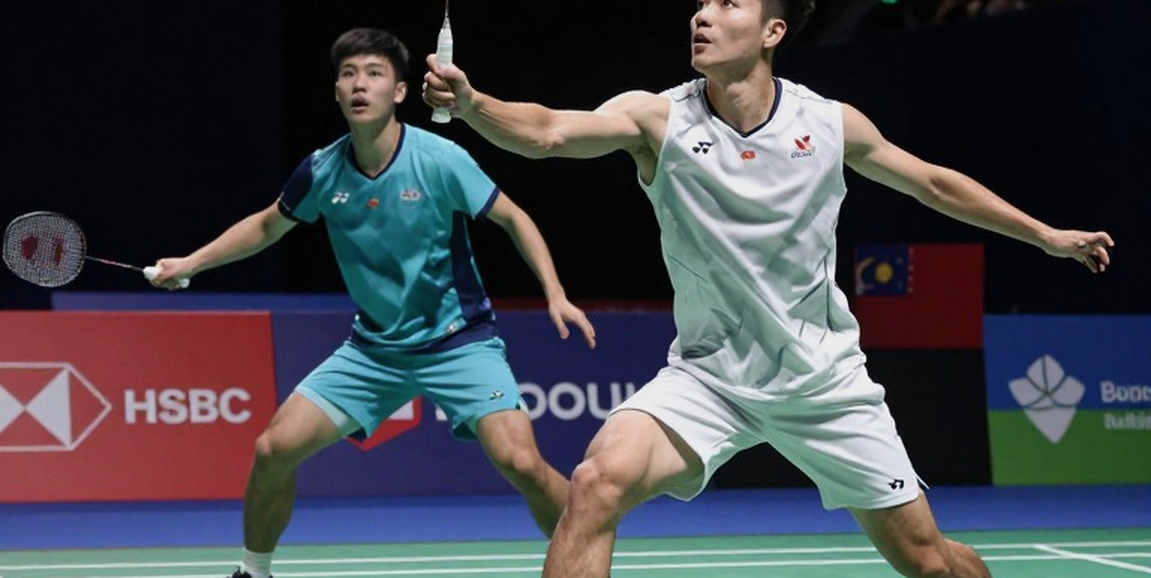
Indonesia did not arrive at the semifinal on a carpet. In the quarterfinal it edged Malaysia 3-2. In a team format, where every rubber is a point of survival, a single dip from one player can cost the whole squad. Against Thailand in the semifinal, Indonesia won more clearly at 3-1, but the internal script drew two opposite pictures: the doubles pairs dominated, while the opening singles lost in a way that is hard to explain.
The 2026 Asian Games are being held in Aichi-Nagoya, Japan. Badminton sits inside the multi-sport framework of the continental Games. The men's team format has five rubbers — three singles and two doubles — played in the order singles, doubles, singles, doubles, singles. In this semifinal, Indonesia closed the tie after four rubbers, reaching three points before the fifth was needed. The meaning of this Games goes beyond individual ranking: it is a stage for national prestige, for selection credibility, and for behind-the-scenes investment. Winning here unlocks an entire funding cycle.
While the men's team advanced, Indonesia's women's team fell in the semifinal to China. That detail matters. It loads all expectation onto the men, and it turns the coming final into a chance for Indonesia's first gold of the Games. The pressure seeps into every shuttle, even if it never shows on the scoreboard.
On the other side of the draw, China and India are contesting the remaining spot. At the time the report was published, China led India 2-1 with the fourth doubles rubber in progress. Indonesia's final opponent, then, remains a question mark — and that question mark makes re-reading the semifinal all the more necessary.
CORE ANALYSIS: THE ANCHOR IS IN DOUBLES
Looking at the four rubbers played in the semifinal, Indonesia's winning structure becomes clear: the two doubles pairs carry the load, and one more singles point is enough to finish the job.
The first pair, Fajar Alfian and Muhammad Shohibul Fikri, won 21-13, 21-19. The second pair, Leo Rolly Carnado and Daniel Marthin, won 21-15, 21-13. Both wins ended in two games — meaning no third game, no window for the opponent to recover and turn things around. The second pair's scoreline is the more striking: 21-15 and 21-13 work out to an average margin of nearly seven points per game, a level of control I rarely see in a decisive team semifinal.

In the second singles, Alwi Farhan won 21-15, 21-13 — matching the scoreline structure of the second doubles pair, and that is no coincidence. When two matches of different disciplines share the same per-game margin, it usually reflects a stable mental state rather than a single burst. Alwi Farhan entered as a young player handed the second singles slot in a team semifinal — a call the Indonesian coaching staff had to weigh carefully — and he answered with two decisive games.

The opening singles drew the opposite picture. Jonatan Christie lost 17-21, 14-21. Game one can still be read as a narrow loss. But game two, with a seven-point margin, shows the player lost control. That signal must be read correctly. If his opponent was Kunlavut Vitidsarn — and the name in the source may be a transliteration variant — this is a defeat to a high-quality opponent, far easier to explain than a shock. If not, it is a form flag worth tracking closely.
From these four rubbers, the first tactical conclusion emerges: Indonesia's win is built on the reliability of the two doubles pairs, and that structure only holds when the second singles delivers. Had Alwi Farhan also lost, Thailand could have levelled, and the story would have turned.
This leads to an observation about space. In doubles, the decisive gap is not on the court surface but in the rhythm of coordination — in the interval between a pair's two shots. When a pair wins by six to seven points on average, that outcome rarely comes from flashy rallies, but from closing that interval, denying the opponent enough time to shift into attack. The scoreboard does not display this data, yet it is what produces the scoreboard.
By estimate from score margins, Indonesia's two pairs controlled roughly two-thirds of the decisive rallies in their winning games. To be clear: this is a conditional inference, not a direct measurement, since the source provides no shot-level data. I leave it in that state rather than turning it into an absolute truth.
PROFILES OF THE TWO PAIRS
Fajar Alfian and Muhammad Shohibul Fikri were placed as the first doubles pair, right after the opening singles. Their 21-13, 21-19 win shows an ability to close a game while leading — a mental skill as important as technique. Game two was tighter than game one, which often happens when an opponent adjusts after a heavy loss, yet the Indonesian pair kept control.
Leo Rolly Carnado and Daniel Marthin played the second doubles rubber, the match that could seal the tie if Indonesia already had two points. The pressure there is heavier than it looks. They won 21-15, 21-13, and the stable margin across two games shows sustained control rather than a one-off burst.
What the two pairs share is that they did not let their matches go to a third game. In team format, that has clear strategic meaning: a third game means burning extra stamina for later rubbers, and it means opening one more psychological variable. Indonesia closing both doubles in two games preserves resources for the final — a quiet advantage few notice.
DECODING THE DOUBLES PATTERN
In modern men's doubles, three factors decide a match: net control, the quality of the opening shot, and the ability to switch between attack and defence. The scoreboard does not show these three directly, but it leaves traces.
When a pair wins 21-13, what usually happens is that they hold net control for most rallies. Net control forces the opponent to lift, opening finishing chances from the back court. Conversely, a tighter score like 21-19 often signals long exchanges where both sides keep rhythm and the difference lies in a few decisive moments.
In this semifinal, the pair of Fajar Alfian and Muhammad Shohibul Fikri experienced both states: dominance in game one and a harder fight in game two. Leo Rolly Carnado and Daniel Marthin maintained stability throughout. This is valuable detail, since stability in knockout matches often matters more than a temporary peak.
It must also be stressed: the original source provides no shuttle speed, rally duration, or rally-win rate. Every judgement here is inferred from scores and context, and should be read that way. There is no statistic to prove one pair is technically superior — only results showing they won.
THE UNANSWERED QUESTION AT OPENING SINGLES
The opening singles is the unanswered question, and it matters more than anything else in the overall picture.
In team format, the number one singles position always carries the heaviest mental load. It opens the tie, and it shapes the mood of the whole squad. A 17-21, 14-21 loss there is not just a lost point — it sends a ripple of doubt into those who follow. As Indonesia reaches the final, the opponent is likely deeper in singles than Thailand. If China advances, Jonatan Christie faces a stronger first singles, and the risk of a repeat is real.
Indonesia's safety margin is therefore thin. A team dependent on two doubles points always plays with a small error tolerance. One slip from a pair — through injury, an opponent figuring them out, or a bad day — collapses the structure, and all pressure lands on the two singles players. Against Malaysia in the quarterfinal, Indonesia won 3-2. That score is evidence the margin was already touched. Had Malaysia had a bit more luck in one of the two doubles, the outcome would have differed.
There is a worrying data gap in the source itself. The other semifinal between China and India contains an inconsistency: one point says the Chinese pair won the first game, but the attached score is 16-21 — a level that normally indicates a loss. This kind of error makes further analysis impossible without verification against official results. As an analyst, I leave this pending rather than forcing an interpretation.
The deepest contrarian point lies here: a team strong in doubles but doubtful in first singles is not a balanced team — it is a team designed to play with a small error margin. That strategy works when everything goes to plan, but it is costly when one link comes loose.
ALWI FARHAN AND GENERATIONAL TRANSITION
One notable signal: the coaching staff handed the second singles slot to Alwi Farhan, a young player, in a team semifinal. It is a signal of future investment, and he answered with two controlled wins.
If the trend continues, Indonesia may gradually fill its singles gap — exactly what it needs to escape its doubles-only identity. Among Asia's leading badminton nations, generational transition in singles usually takes several tournament cycles. Putting a young player into a decisive team match is a step usually taken only when the staff believes long-term gain outweighs immediate risk.
It must be said: the source gives no data on Alwi Farhan's long-term form, ranking, or head-to-head record. Every judgement here stops at single-match results. That limit should be acknowledged rather than papered over with speculation.
Another tactical note: placing a young player in the second singles, not the third, shows the staff want him tested under pressure in a match that can decide the tie. This is a typical way of building mettle in national badminton systems. But it also raises the question of the young player's tolerance threshold when the final opponent is stronger than the semifinal one.
THE ASIAN LANDSCAPE AND INDONESIA'S POSITION
Placing Indonesia on the map of Asian team badminton reveals a multi-polar layout. At the top tier are China and Indonesia — two traditional badminton nations with centralised training systems. Just below are India, Thailand and Malaysia, teams with formidable singles depth. Further out are Japan and South Korea, names always present in team races.
In that layout, Indonesia holds the position of a doubles power with singles still open. That creates two fairly distinct final scenarios.
If China reaches the final, Indonesia faces a team with superior singles depth. To win, Indonesia would almost certainly need both doubles points and a breakthrough in one singles rubber. It is a gamble that can land but can also break.
If India reaches the final, the picture is softer. India has a balanced squad, but Indonesia's edge in the two doubles pairs could be decisive. India's tight semifinal against China also shows China is not invincible in team format — a sign Indonesia's door stays open, though not wide.
One narrative detail, to be read as such: if China reaches the final, the clash could be framed as a rematch, after Indonesia's women's team lost to China in the semifinal. This is purely narrative inference, not tactical fact, and I rate it low confidence.
On squad depth, Indonesia currently shows relative strength in doubles but a lack of matching stability in singles. A badminton nation wanting to hold a top position long-term must balance both. China once solved this by building depth in parallel. India is following a similar path with a fast-professionalising system. Indonesia, on available data, still leans more on its doubles.
FORMAT, RULES AND WHAT IS NOT SAID
No regulatory dispute appears in the source. All information revolves around match results. That means institutional risk for the final, on available data, is rated low.
Still, a few points deserve attention. Multi-sport Games usually apply tighter athlete-registration windows than specialist tournaments. If the roster is locked before the final, Indonesia can hardly swap an out-of-form player. This is unverified inference, since the source does not mention registration rules.
On point mechanics, team events at continental Games are usually not counted into the World Badminton Federation's individual ranking system in the usual way. Their meaning lies in medals and national prestige more than in defending a ranking position. That explains why teams pour resources into team format, even when it yields no individual points.
One more regulatory note: the inconsistent point in the source for the other semifinal should be checked against official results before any use. Data verification is not a small detail — it is the condition for every downstream conclusion to hold.
COACHING AND SUPPORT SYSTEM
Information about Indonesia's coaching staff in the source is nearly absent. There is no data on coaching style, staff stability, or technical-analysis facilities. Any judgement on coaching quality here stops at inference.
Even so, one thing can be read from the personnel call: trusting two doubles pairs and a young player in the second singles shows the staff understand their strengths and are not afraid to load responsibility there. In national badminton systems, such decisions are usually made after layers of internal analysis — from head-to-head history, physical state, to match psychology. To repeat: this is inference, not fact.
On support systems, the source reports nothing about training staff, strength-and-conditioning and recovery personnel, or the level of analytical technology. This is a blank space to be filled in later reports. In modern badminton, the gap between two top teams usually lies not in individual technique, but in the system behind the court.
A LITTLE FROM MY OWN WATCHING EXPERIENCE
Over years of covering team events, I have noticed a recurring pattern: team results rarely reflect true overall strength. They reflect the order of play, the fit between positions, and the pressure tolerance of the very people given responsibility. This semifinal is another case in point.
When following Indonesia's matches at past Games, I usually take notes in three layers: the score layer, the doubles-rhythm layer, and the mental state of the opening singles player. Against Thailand, the first two layers matched — the result reflected real control. The third layer diverged: an opening singles player lost in a way that shows an unresolved problem. If I had to pick one indicator to track in the final, it would be this third layer, not the scoreboard.
That approach stems from a habit of questioning environmental variables before every match: court conditions, schedule, psychological state. In team format, these variables compound and amplify each other. An opening singles loss can make those who follow play smaller; conversely, a fast doubles win can release tension for the whole team. That is why I rarely conclude from a single match.
I have also seen cases of teams strong in doubles winning group matches in a row, then collapsing in the semifinal when an opponent prepared specifically for those two pairs. The lesson repeats: the gap never lies — we simply are not calm enough to listen. And the empty court turns out to be the perfect laboratory of modern badminton, where every assumption is tested by results.
A CLOSING POINT TO VERIFY
Indonesia cannot be judged weak or strong from a single semifinal. What can be stated is that its winning structure is now clear: two doubles points as the base, the second singles as the anchor, and the first singles as an unsolved variable.
If China reaches the final, that variable will be pushed to its most dangerous level. If India reaches the final, the gap may be better hidden — but it is still there.
With the women's team already out in the semifinal, Indonesia's men's team stands before a chance at the delegation's first gold of the Games. But as in badminton, what decides is usually not the final score, but the interval between two shots — in the moments few people watch.
The question left for the final: if one of the two doubles pairs no longer holds that control, who fills the gap? The coming match will answer. A line-up does not need to be excellent in every position, only free of any forgotten link.