
British table tennis SBCL Premier opener: Alcayde unbeaten all weekend, youth side eBaTT topple the former champion
**Câu trả lời cốt lõi**: Vòng mở màn SBCL Premier Division (giải đồng đội hàng đầu Anh, do Table Tennis England công bố) chứng kiến BATTS và Ormesby cùng dẫn đầu, Guillaume Alcayde (Pháp) của DHS Hurricane Kingsway giữ thành tích toàn thắng, và đội trẻ eBaTT (tổng tuổi 71) đánh bại cựu vô địch Ormeau 4-3. **Dữ kiện chính**: - Guillaume Alcayde (Pháp) duy trì tỷ lệ thắng 100% suốt vòng mở màn, gồm cả trận đôi, cho DHS Hurricane Kingsway. - Edouard Valanet (Pháp) của BATTS thắng 2 trận ra mắt rồi thua 0-3 trước Nahom Asgedom (eBaTT). - eBaTT ra sân với đội hình trẻ nhất lịch sử BCL Premier, tổng tuổi 4 tay vợt là 71. - Max Radiven (eBaTT) giành thắng lợi Premier Division đầu tiên, hạ Kingham 12-10 ở ván quyết định. - Bảng xếp hạng SBCL phân định bằng chỉ số “sets for” (tổng ván thắng), BATTS hơn Ormesby ở chỉ số này. - Nhiều ván quyết định kết thúc ở 12-10, 13-11, 15-13, cho thấy phần giữa bảng bị nén rất chặt. **Nguồn**: Table Tennis England — bản tin kết quả SBCL Premier Division, vòng mở màn mùa giải hiện hành. **Hỏi đáp liên quan**: - Hỏi: Ai là tay vợt nổi bật nhất vòng mở màn SBCL Premier Division? Đáp: Guillaume Alcayde (Pháp, DHS Hurricane Kingsway) với thành tích toàn thắng xuyên suốt cuối tuần. - Hỏi: Vì sao BATTS dẫn trước Ormesby trên bảng xếp hạng? Đáp: Do thành tích “sets for” (tổng số ván thắng) tốt hơn, theo quy định riêng của SBCL. - Hỏi: Dấu hiệu công nghiệp đáng chú ý nhất từ vòng đấu là gì? Đáp: Thương hiệu thiết bị Trung Quốc DHS xuất hiện qua tên đội DHS Hurricane Kingsway, cho thấy hãng này đang mua suất hiện diện tại thị trường câu lạc bộ Anh.
In the results bulletin for the opening weekend of the SBCL Premier Division, published by Table Tennis England, one sequence of numbers repeats with suspicious frequency: 12-10, 13-11, 15-13. Across different fixtures, across different clubs, the deciding games all ended by a two-point margin.
I have sat in front of table tennis score sheets long enough to know that sequences like this do not appear by accident. When a game runs to 15-13, it signals one of two things: two players so evenly matched that every serve becomes a weapon, or one player losing composure at the exact moment composure matters most. Both are worth tracking. At the opening weekend of England's top club competition, both appeared at once.
Context: a league the outside world barely notices
SBCL Premier Division — the Senior British Clubs League, the top tier of the English club system — runs on a weekend-block format. Teams do not play one match a week as in most European national leagues; fixtures are compressed into weekend clusters, two matches per day, each tie comprising seven individual and doubles matches. That is the single most important physical-load detail, and I will return to it at the end.
A team fields four players. The order within the side is set in advance, and doubles pairings are fixed for given phases. No world ranking points are awarded. No prize money is published. Measured against the international circuit, the event's value is close to zero.
Read the bulletin closely, though, and three real signals emerge: labour mobility of European players into the British market, the penetration of Chinese equipment brands into Western club systems, and the depth of domestic youth development. These signals almost never surface on the WTT circuit. They only surface at club level.

Eight clubs took part: BATTS, Ormesby, Fusion, Ormeau, North Ayrshire, DHS Hurricane Kingsway, Nottingham TTC and eBaTT. Of those, DHS Hurricane Kingsway and Nottingham TTC are promoted sides. Ormeau are the 2026/23 champions.
The core: reading a results sheet like a power map
The first thing the sheet tells me is a two-pole structure. BATTS and Ormesby share the lead after the opener, and both produced absolute whitewash wins. A 7-0 margin in this league means winning all seven individual matches in a tie — a result that only happens when the gap in standard exceeds a full tier.
The standings, however, are separated by a metric few outsiders know: the “sets for” record, the total number of games won. BATTS lead Ormesby on a better sets-for record, not on a superior win count. This is an SBCL-specific regulation, entirely different from WTT scoring. For anyone tracking the league, it means every game won carries cumulative value, even inside a tie already decided. Coaches here are forced to manage games that no longer affect the result.
But the most interesting part of the weekend was not at the top.
Guillaume Alcayde (France) — DHS Hurricane Kingsway
The promoted side DHS Hurricane Kingsway sit third after round one, anchored by Guillaume Alcayde, the French player who maintained a perfect record through the entire weekend. A distinction matters here: Alcayde did not win one match and get embellished. He sustained a 100 percent record across the whole weekend block, doubles included. That is the only durable individual metric a single weekend can supply.
With my background as a transfer-market administrator, I read Alcayde differently. A French player holding an anchor role at a newly promoted English club is a familiar European table tennis model: clubs buy a first-singles slot rather than develop one. Every promoted side carries an anchor figure — and at Kingsway, that anchor is French. The detail says a good deal about the thickness of English domestic resources in the anchor positions.
Edouard Valanet (France) — BATTS
At the other end of the spectrum, Edouard Valanet is BATTS's new international signing. His debut was flawless: two wins on day one. Local coverage quickly attached the label “new international star.”
Then came match three. Valanet lost 0-3 to Nahom Asgedom, a young eBaTT player. A 0-3 scoreline is not a close contest. It is a complete shutdown.
I do not believe in miracles; I believe in the probability of putting on the shirt. A flawless debut plus a straight-games defeat in the same weekend produces no conclusion at all. It produces a wide confidence interval. Attaching a “star” label after two wins is a very common form of journalistic self-deception — and I have fallen into precisely that trap myself, just in football rather than table tennis.
eBaTT — the youngest side in league history
This is the part that made me reopen the dataset a third time.
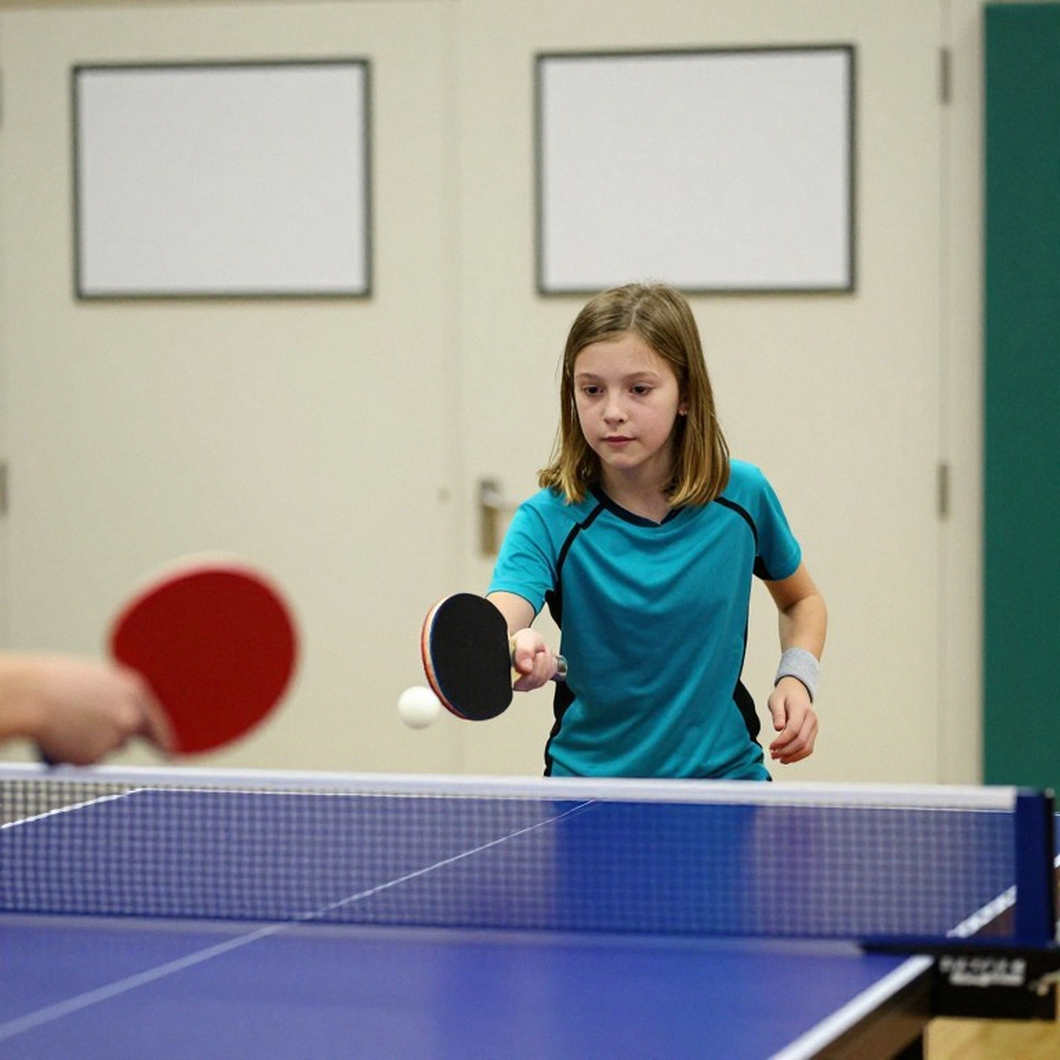
eBaTT fielded one of the youngest sides in BCL Premier history. The combined age of their four players is 71 — an average of under 18. The squad: Vlasov, Asgedom, Radiven and Piwowar.
And they beat Ormeau, the 2026/23 champions, 4-3.
The two standout individual wins: Nahom Asgedom over Valanet 3-0, as noted; and Max Radiven — an England youth teammate of the same age group — claiming his first career Premier Division win on a 12-10 decider against Kingham. Kingham is an England international. Radiven won by two points.
A teenage player beating a national-team player by two points in a deciding game. In my spreadsheet, that is noise. But emotion is noise in the data — and beyond a certain threshold, noise becomes signal. If a youth pipeline keeps producing noise like this, the problem is not the data. The problem is that we are measuring the wrong thing.
Ben Piggott (Ormesby) — a high-variance profile
If Alcayde is the stable archetype, Ben Piggott is its mirror. He won a decider 12-10 against Sawyer. He came back from 2-0 down. He won two fifth games in a single weekend. He also lost 3-1 to Johnson, and lost 12-10 in a fifth game to Shilton.
Piggott is a high-volume, high-variance player: his game-win count is large, and so is his count of narrow defeats. Under the SBCL's sets-for format, that profile carries more practical value than it appears to, because every game won feeds the tiebreak metric that separates the standings.
Billy Shilton (North Ayrshire) — and the silence of a team
Billy Shilton is a Paralympic medallist. He plays for North Ayrshire, a Scottish side. This weekend Shilton repeatedly forced deciders, beat Piggott 12-10, and featured in the fixed doubles pairing with Johnson. His team still lost.
This is the point individual stat sheets never capture. A player can win enough games to prove his class, and his side can still walk off with nothing.
Family fixtures and fixed pairings
At Fusion, Larry and Lorestas Trumpauskas — father and son — both took the table. Larry typically opened; Lorestas typically levelled or came back. Both lost 0-3 to Sawyer. The presence of a father-son pair in England's top club tier says what metrics cannot: the British club system allows multi-generational rosters.
On tactics, one detail deserves a pause: the bulletin notes that “Mendes and McBeath combined as usual.” That phrase “as usual” matters more than it looks. It confirms that in this league, doubles pairings are deliberately fixed, and the doubles match is treated as a strategic scoring unit. Shilton and Johnson are likewise a fixed pairing.
Contrarian angle: numbers do not lie, but they know how to make people lie to themselves
What the round-one sheet suggests — and what is most easily misread — is the relationship between team scorelines and individual standard.
When BATTS and Ormesby win 7-0, it is tempting to conclude that the gap between the top and the rest is enormous. Look at the individual games, though, and the picture changes colour: deciders across multiple fixtures finished at 12-10, 13-11, 15-13. At game level, the middle of the table is compressed very tightly.
Team scoreline correlation is not causation of individual standard gap. A side can win 7-0 while passing through four deciders, simply because its four players are collectively better at the last two points. And a side can lose 1-6 while fielding three players level with their opponents.
This is the blind spot of every standings table built on team results. The table measures outcomes. It does not measure distance.
Industry signal: the name on the shirt
At industry level, one detail is easy to miss. The team name “DHS Hurricane Kingsway” carries two commercial elements: DHS — Double Happiness, the Chinese table tennis equipment manufacturer — and Hurricane, that company's flagship rubber line.
A Chinese equipment brand is buying visibility in the British club market, rather than only appearing on the world-championship stage. That is a commercial transmission signal running from upstream (equipment manufacturers) to downstream (local clubs), and the direction differs from how table tennis brands usually appear: attached to stars on the WTT circuit.
Alongside it, the bulletin records a small but meaningful detail: this was the season's first live-streamed fixture. At club level, investing in streaming points to a different commercialisation path — selling audience rather than selling glory.
Labour mobility
At this round, at least three foreign nationalities appeared in lineups: Alcayde (France), Valanet (France), Monzo (Spain) at Ormeau, plus a Japanese-named player, Morota.
The English club league is operating as a labour market for continental professionals. The phenomenon has existed for decades in European table tennis, but its scale at an English semi-professional event is worth recording.
Oriol Monzo of Ormeau is a two-sided example. He won a singles match, featured in the doubles, but lost a decider to Webb-Dixon and lost to Larry Trumpauskas. A Spanish player can beat one English opponent and lose to another in the same weekend. That is a marker of evenly matched quality in the middle of the table.
Takeaway: signals for the next round
Round two will answer what round one cannot.
First, can eBaTT hold form after beating Ormeau, or was that a variance peak? A squad averaging 17.75 across a weekend block of two matches per day is a severe physical test — and the bulletin says nothing about rotation. If heavy defeats arrive in round two, that is load data, not ability data.
Second, will Alcayde maintain his perfect record? It is the clearest individual metric of round one, and also the most fragile.
Third, can DHS Hurricane Kingsway — promoted, third — convert that start into a challenge to the top two? The standings gap between third and second is small. The squad-depth gap between third and second is unknown.
One final detail. The original Table Tennis England bulletin was cut mid-sentence, at a reference to the “Philippines national” team. There is a second story behind this bulletin that I have not yet read. I will go looking for it before the next round.
Summer 2026: Salah crossed the line, and every spreadsheet of mine collapsed. The lesson from that summer still stands: I do not write about what the spreadsheet asserts. I write about the distance between what the spreadsheet asserts and what actually happens at the table.