
Chuncheon 2026: Vietnam's Poomsae Mixed-Pair Gold and the Baton-Passing Test
Core answer: Tại Chuncheon, Hàn Quốc, cặp Nguyễn Thị Lệ Kim và Nguyễn Thiện Phụng giành HCV nội dung đôi nam nữ quyền thuật chuẩn U50 tại Giải vô địch Taekwondo quyền thuật thế giới 2026, sau khi hạ Đan Mạch ở chung kết. Key facts: - Chung kết gặp Đan Mạch; đường đi qua Myanmar, Trung Hoa Đài Bắc, Thổ Nhĩ Kỳ, Iran; trường đấu 27 cặp. - Nguyễn Thiện Phụng có hai HCV đôi nam nữ U50 liên tiếp (2024 và 2026) với hai bạn diễn khác nhau. - U50, U40, U30 là nhóm tuổi, không phải hạng cân; quyền thuật WT không có bàn cân. - Giải 2026 tổ chức tại Chuncheon, Hàn Quốc; kỳ 2024 tổ chức tại Hồng Kông. - Đây là HCV đầu tiên của đoàn Việt Nam tại kỳ 2026, không phải HCV đầu tiên của nội dung này. Source attribution: Bản phân tích chuyên môn Stage-2 dựa trên báo cáo kết quả Giải vô địch Taekwondo quyền thuật thế giới 2026 | Cross-checked: VuaBong.vn Related Q&A: Q: Việt Nam có bảo vệ thành công HCV đôi nam nữ quyền thuật không? A: Có; đây là HCV thứ hai liên tiếp ở đúng nội dung U50, với bạn diễn nữ thay đổi so với năm 2024. Q: Vì sao HCV này không đồng nghĩa Việt Nam ngang bằng Hàn Quốc ở quyền thuật? A: Nhánh đấu không có vận động viên Hàn Quốc, quốc gia giữ chuẩn mực kỹ thuật của bộ môn. Q: Quyền thuật có hạng cân không? A: Không; WT quyền thuật chia theo nhóm tuổi (U30, U40, U50), không theo cân nặng.
At Chuncheon, when the referees announced the score in the mixed-pair poomsae event, I did not look at the scoreboard. I looked at Nguyen Thien Phung's foot.
That habit was formed on afternoons in Da Nang, sitting beside the training mats, logging every sign of ankle-axis deviation in young athletes. A poomsae athlete jumps and lands on the ball of the foot. If the load is uneven, the ankle reports it before the scoreboard can move.
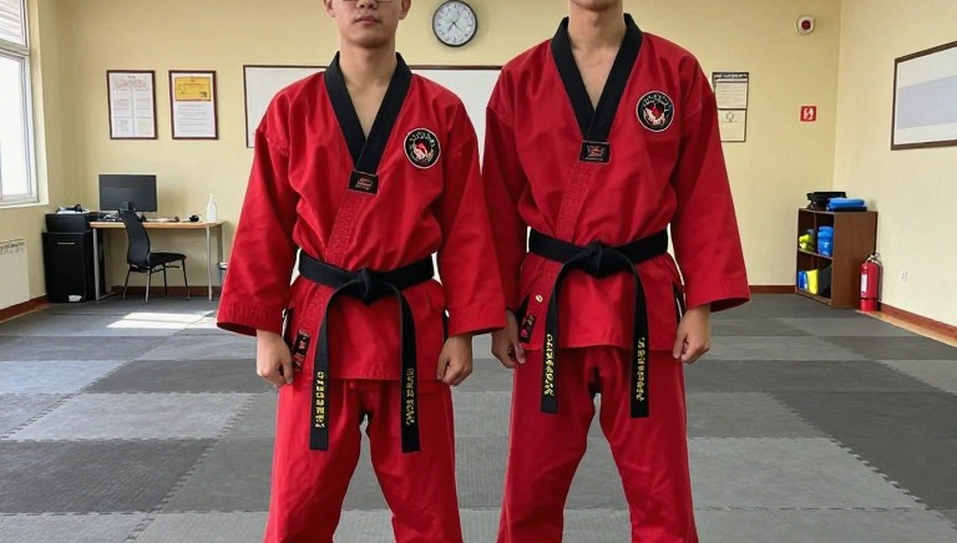
The pair of Nguyen Thi Le Kim and Nguyen Thien Phung went through Myanmar, Chinese Taipei, Turkey and Iran, then beat Denmark in the final. A 27-pair bracket. Gold. And inside that short news line sits a detail most newsrooms skipped: this was a handover, not a title defense.
Poomsae is the demonstration branch of taekwondo, not combat. No landed strike, no knockout, no overtime round. An athlete steps onto the mat, performs a prescribed sequence, and a judging panel scores accuracy plus presentation — speed, power, rhythm, expression.
The event in question is standard (recognized) poomsae, the fixed-form system of World Taekwondo. There is no freestyle technical-difficulty score. The competitive weapon therefore is not movement difficulty but execution consistency and synchronization between two athletes.
This is where many readers misread the result. The labels U50, U40 and U30 on the bracket are age divisions, not weight classes. WT poomsae has no bodyweight, no scale, no weight cut, no rehydration. Any "weight class" reading of this event is wrong at the root.
The 2026 World Championships took place in Chuncheon, South Korea — the sport's birth nation. The previous edition in 2026 was held in Hong Kong. Same event category, same champion nation, different people.
In 2026 the champion pair was Chau Tuyet Van and Nguyen Thien Phung. In 2026, coach Nguyen Thanh Huy brought Nguyen Thi Le Kim in to replace Chau Tuyet Van. The result did not change.
The retained variable is the male half of the pair. Nguyen Thien Phung now holds two consecutive World mixed-pair U50 golds with two different partners. In a discipline judged by human eyes, that is the most defensible strength signal this story offers. An athlete can get lucky once. Twice, with two different partners, is hard to call luck.
Swapping partners does not erase the underlying problem: both times, the pair still depended on one athlete. The crack never heals; it is only painted over in a prettier color.
Behind that result sits a concrete training structure. Mixed-pair poomsae demands near-absolute synchrony: same release, same hip rotation, same stance drop. A fraction of a second off in the stance costs presentation points. Changing partners means rebuilding the body's entire biological clock to match a new person. Vietnam's squad did that inside one cycle, and it worked.
Nguyen Thi Le Kim carried the squad's heaviest load. She was in the gold-winning pair, and the next day appeared in the women's team event. Two events at a world championship is a notable competition load for a young athlete being pushed upward.
Chau Tuyet Van appeared in both U40 individual and U50 pair/team. A poomsae athlete standing in two age brackets at one championship shows the coaching staff is deliberately picking the bracket with the highest medal probability. The crack of age in poomsae is not in reflexes; it is in hip range and ankle bounce — things that fade season by season. There is no scale to measure it, only the age-bracket ceiling as a boundary. Once an athlete hits the bracket ceiling, their competition window closes by calendar, not by form.
Another structural point: the bracket contained no South Korean athletes. South Korea is the technical benchmark of world poomsae. That absence made the bracket more open.
No specific scores, no point margins, no opponent seeding. A path across four continental confederations — Asia with Myanmar, Chinese Taipei and Iran; Europe with Turkey and Denmark — is a credible breadth test. But the level of dominance cannot be measured.
Media framed this gold as "Vietnam's first gold of the championship." That is true in a narrow sense: first gold of the 2026 edition, not the first gold in this event's history. Vietnam won the mixed-pair standard U50 in Hong Kong in 2026. This is a title defense, not a breakthrough.
That ambiguity matters, because it shapes how we read the next cycle. A team defending a title while the discipline's technical benchmark is absent is in a very different state from a team reaching the summit for the first time. Markets have windows; human bodies have death doors — and in poomsae, the "death window" is not the 60-to-75-minute phase of a match, but the age-bracket line that closes behind an athlete.
The real value of the gold lies in justifying training funding and retaining the next generation. Poomsae is funded by federation budgets; there is no ticket revenue, no broadcast contract. Based on my experience following domestic competitions, the cash bonus usually covers one training cycle at most, while what keeps athletes on the mat is competition slots and a pathway to the national team.
On the physical price: poomsae is nearly immune to the heaviest risks of martial arts. No head contact, so no brain injury. No weigh-in, so no fatal weight-cut case. What remains is micro wear — ankle, knee, hip, hamstring — accumulated across thousands of jump kicks in the training hall. Injury is the indictment the body writes against the competition calendar, but in poomsae it is written in faint ink and slowly enough that nobody reads it.
Nguyen Thien Phung is the renewable asset of this program. Nguyen Thi Le Kim is the successor being load-tested. Chau Tuyet Van keeps the rhythm through the transition. Those three pieces shape the next cycle — but whether that cycle takes shape depends on a decision made off the mat: whether the federation has the patience to raise the next generation through two gold-less years, or instead hunts for another mixed-pair slot to protect immediate results.
Cầu thủ liên quan
Bài đề xuất
Vietnamese Martial Arts in Transformation: From Traditional Schools to Professional Arenas — The Silent Revolution and Ongoing Debates2026-09-20
From Yongin to Aichi-Nagoya: The Pulse of Vietnam's Taekwondo Ahead of the 2026 Asian Games2026-09-18
Four Kilos and Two Medals: The Unwritten Equation in Vietnam's Taekwondo Asiad Plan2026-09-18
Vietnam Taekwondo and the Two-Weight-Class Gamble at the 2026 Asian Games2026-09-18
Misclassify the Discipline and the Analysis Breaks2026-09-14
Bài đề xuất
The 7-Year Cycle on the Track: Why Athletes Born in 2026-2026 Are Reshaping World Athletics2026-09-14
From Yongin to Aichi-Nagoya: The Pulse of Vietnam's Taekwondo Ahead of the 2026 Asian Games2026-09-18
The Breath After the Punch: When Hanoi's Oldest Fighter Teaches Us a Lesson in Silence2026-09-12
Cannot Create Sports Article Due to Missing Input2026-09-09
Vietnam Taekwondo at Asiad 2026: Two Women's Weight Classes Carry the Entire Medal Ceiling2026-09-18
Bài đề xuất
Twelve Years, Sixteen Reigns: The UFC Heavyweight Beat, Heard From a Gym in Nha Trang2026-09-19
Chuncheon and the Synchronization Equation: Decoding Vietnam's World Poomsae Gold2026-09-18
The Breath After the Punch: When Hanoi's Oldest Fighter Teaches Us a Lesson in Silence2026-09-12
The Broken Analysis Chain: When an Empty Data Cell Is the Most Important Finding2026-09-14
When martial arts analysis falls into a void: Lessons from an all-N/A report2026-09-08